Food Packaging: How to Balance Product Protection, Shelf Life and Sustainability
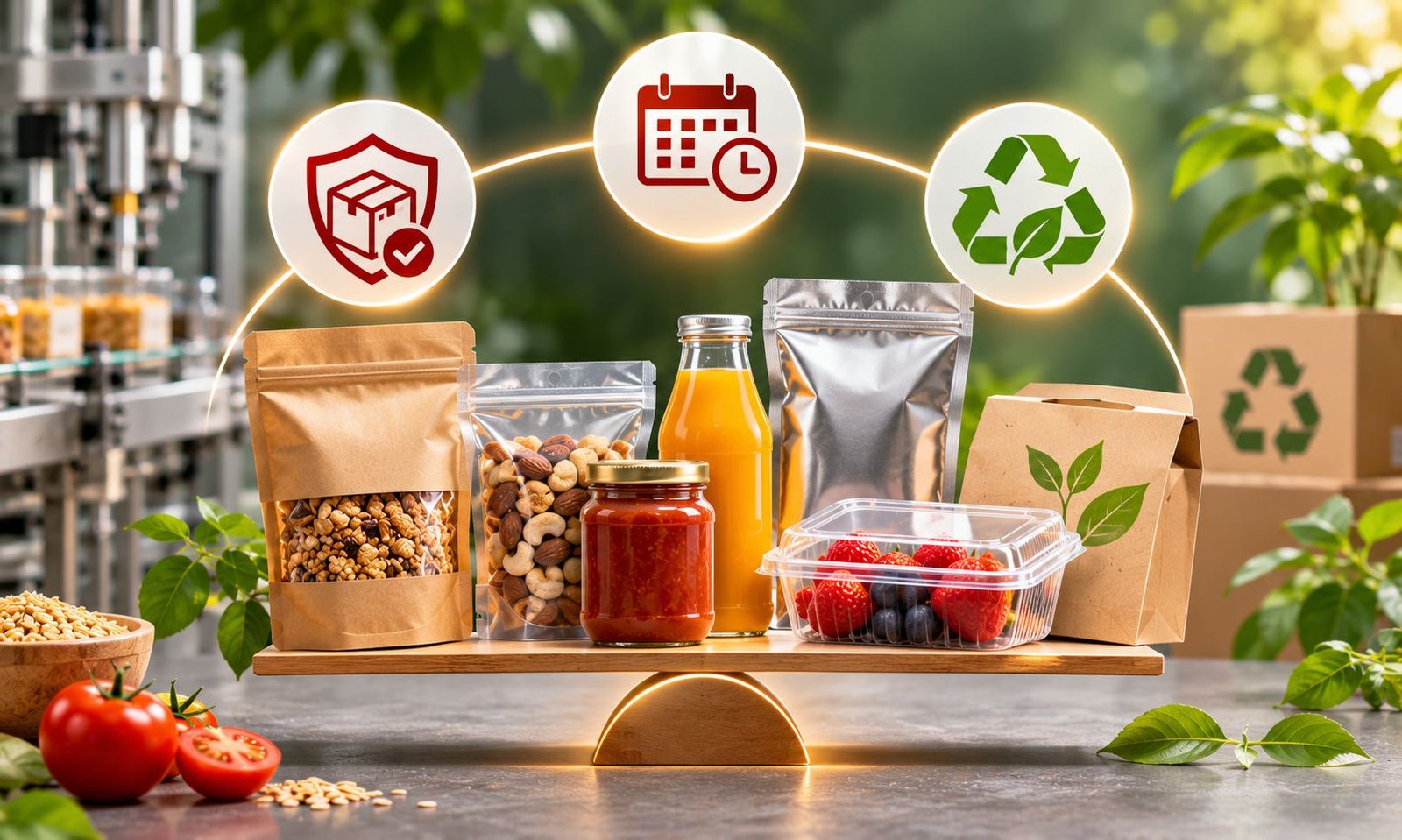
Food packaging does much more than display a brand. It protects products during handling and distribution, supports product information, and can influence shelf life. Choosing packaging requires a balance between product needs, process compatibility, cost, customer convenience and environmental considerations.
Start with the product’s needs
Identify the product’s sensitivity to oxygen, moisture, light, temperature, physical damage and contamination. A dry snack, an acidic beverage and a chilled ready-to-eat food have different protection requirements. Packaging decisions should follow the product’s risks and intended storage conditions.
Assess barrier and seal performance
Material barrier properties can affect how quickly oxygen or water vapour passes through a package. Seal integrity, closure performance and pack durability also matter. A material with promising barrier properties may still underperform if the package is poorly sealed or incompatible with the filling process.
Check compatibility with manufacturing and distribution
Evaluate filling temperature, line speed, package shape, stacking, transport vibration, storage conditions and retail display. Conduct trials on the actual equipment where possible. Packaging changes can affect production efficiency, leakage, breakage and consumer usability.
Consider food-contact suitability and labelling
Packaging intended for food contact must be suitable for its intended use and comply with applicable requirements in the markets where the product is sold. Review supplier documentation and ensure that the final pack and label are appropriate for the product and process.
Evaluate sustainability with evidence
Consider material use, recyclability in the target market, recycled content where permitted, transport efficiency, product protection and end-of-life infrastructure. A lighter pack is not automatically better if it increases food spoilage or cannot be managed by local waste systems. Avoid broad environmental claims unless they can be substantiated.
Test before making a final decision
Packaging trials can assess sealing, leakage, physical strength, product quality over time and performance during distribution. When packaging is changed, determine whether shelf-life evidence or label information needs to be reviewed.
How MyFoodXpert can help
MyFoodXpert supports food businesses across product development, shelf-life studies, pilot manufacturing and related consulting. Packaging decisions can be considered alongside formulation, process and product-quality requirements.
Conclusion
Effective packaging is a product-protection decision as well as a brand and operations decision. A structured evaluation helps manufacturers select packaging that meets functional needs while making realistic sustainability choices.
Call to action
Evaluating packaging for a new or existing product? Contact MyFoodXpert to discuss your development needs.